
Career prospects
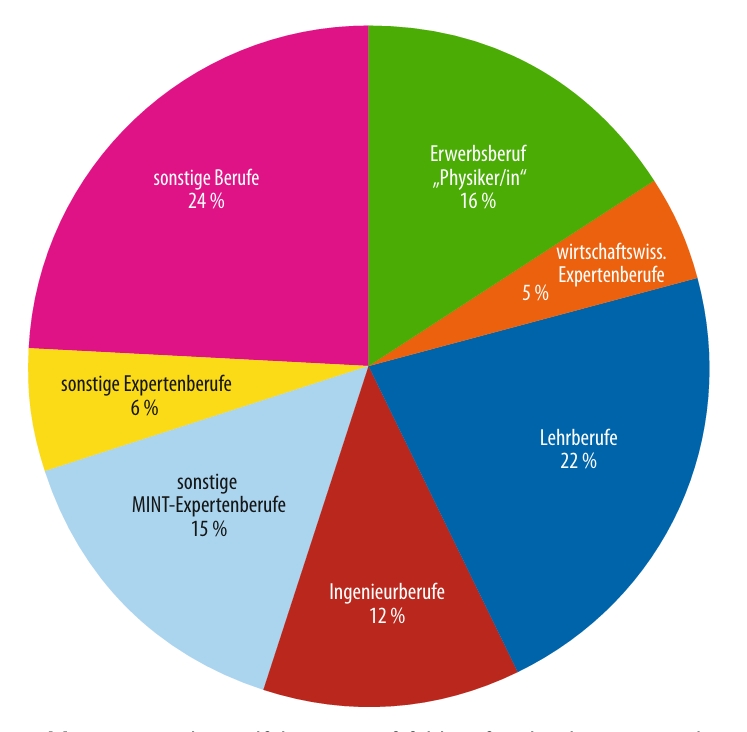
A physics degree is very versatile and provides a wide range of skills. These include not only mathematical methods and physical concepts, but also knowledge of statistical data analysis, programming, and modeling. The skills acquired can be applied in many different professional fields. Physics graduates are therefore not limited to a specific career path but can also find employment in many other divisions. According to a statistical survey from 2022, which included households selected at random, only 16% of individuals with an academic degree in physics later work in the professional role of “physicist” in companies. A large proportion of physics graduates work in fields that extend beyond the traditional role of a physicist. For example, 22% work in teaching professions, such as at schools, universities, or colleges. In addition, 12% of graduates work in engineering professions, while another 15% work in other STEM expert professions. The latter category includes professions in the divisions of mathematics, computer science, and natural sciences and technology that require a high level of specialized knowledge but are not classified as either traditional physics or engineering professions. These include, for example, jobs in software development, data analysis, IT consulting, or other specialized fields in science and technology. Furthermore, 5% of physics graduates are employed in economic expert professions, which include, for example, jobs in finance or management consulting. About 6% are in other expert professions outside the divisions already mentioned; this includes, for example, jobs in political consulting or science journalism. Approximately 24% of physics graduates work in professions that cannot be classified into the previously mentioned occupational groups after graduation.
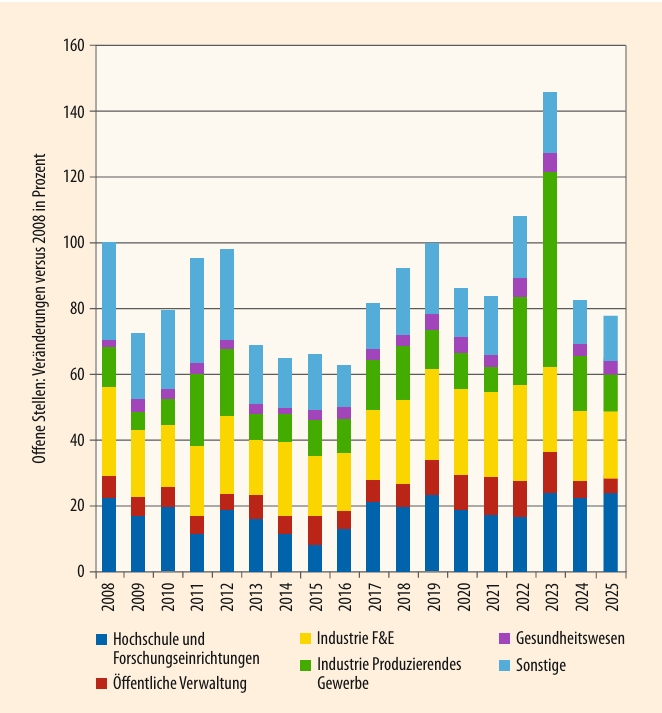
The current economic downturn is also affecting job openings for physicists. According to statistics from the Federal Employment Agency, there will be a slight decline in job openings in manufacturing companies and in the Division of industrial research and development by 2025. For universities and research institutions, however, the statistics show a slight increase in job openings compared to the previous year. The data from the Federal Employment Agency refers exclusively to reported job openings for the occupational category “physicist.” Since physics graduates are also employed in many other occupational groups, these statistics thus only partially capture the actual job market for physicists. With an overall unemployment rate of three percent, however, a degree in physics continues to offer very good prospects on the job market.

...is working as a doctoral candidate at a major aerospace company following his studies at KIT.

...has been working as a test engineer in physical failure analysis since completing her studies at KIT.
link
...currently teaches physics and science and technology (NwT) at a general secondary school.

...is working as a software developer in the Division of Artificial Intelligence following his doctorate at KIT.